
Feeling Moody? Good.
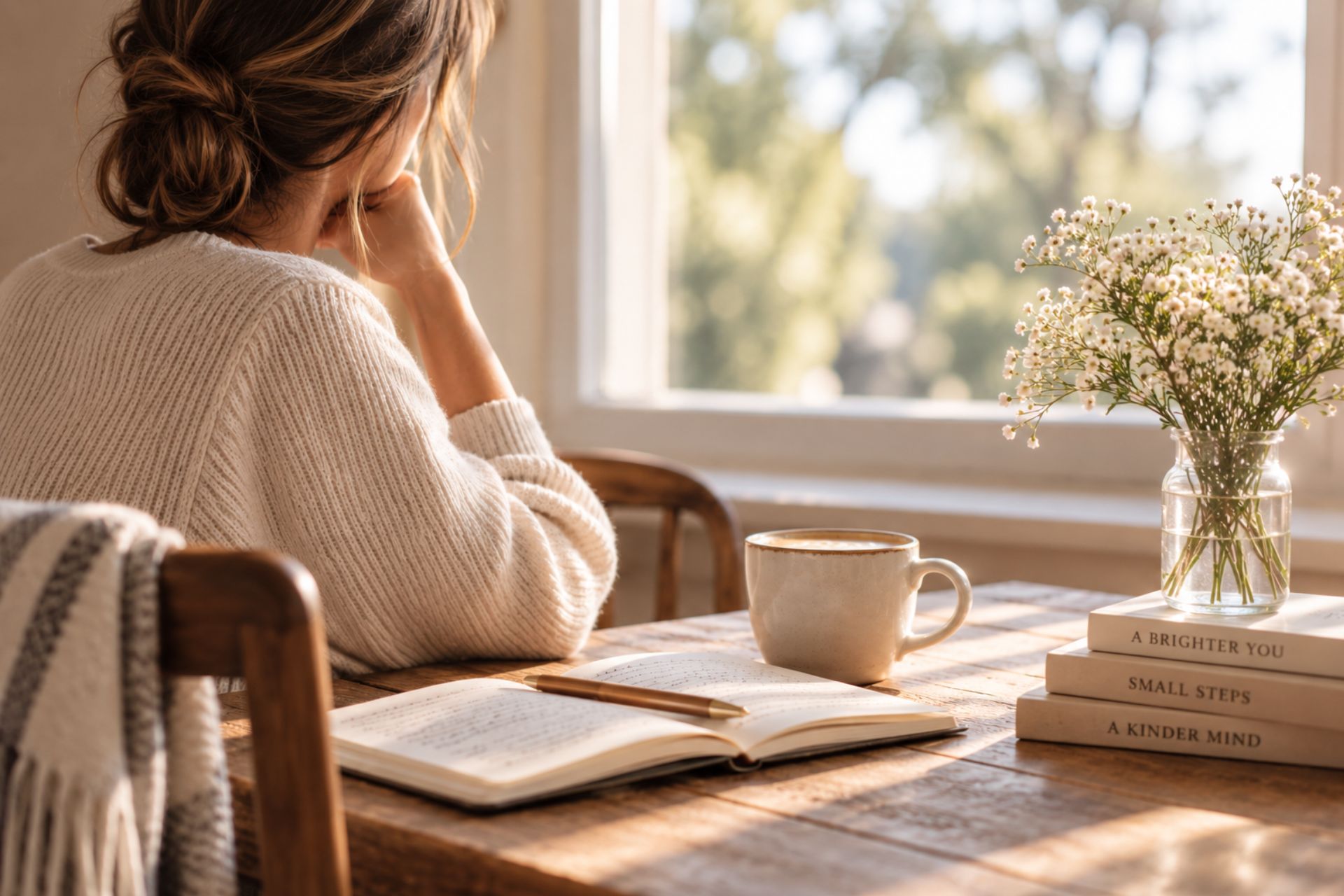
As a psychiatric provider working with women, I don’t think a woman has ever come into my office and not endorsed having mood swings of some sort. The phrases “I’m too much,” “my moods are all over the place,” “I’m so emotional” are practically clinical vernacular at this point. Or the women whose partners are on a quiet little witch hunt for their inner world, “my partner just wants to know what’s wrong with me” (as I try not to spit my coffee across the room).
Almost always, those same appointments begin like this:
Client: “I’m good! How are you?”
And most of the time, especially in the beginning, they are not, in fact, good.
Not because something is wrong with them.
But because somewhere along the way, we collectively decided that anything outside of pleasant, agreeable, manageable was no longer acceptable.
Emotions, at some point in our cultural evolution, became synonymous with weakness.
Or maybe more accurately…they are our greatest intelligence.
Because what I see in these rooms, over and over again, is not dysfunction. It’s sensitivity. It’s perception. It’s a nervous system that is picking up on far more than it was ever taught how to process. Women who have been conditioned to interpret their own internal signals as problems instead of information.
What we call “too emotional” is often just highly attuned.
My own relationship with my emotions has been…an odyssey, to put it lightly.
As a child, a teenager, a young adult, my emotions were wild. If I felt it, so did everyone in the room. I was given all the classics: overdramatic, drama queen, feisty, spirited, passionate. I even had a brief emo phase in high school, thick black eyeliner, spiked belts, an aggressive side-swept bang, and an unnecessary emotional attachment to Converse sneakers.
Unfortunately, I was also…deeply bubbly. So the aesthetic never quite matched the personality.
But the message was clear:
By my late twenties and early thirties, I had learned that my emotions were something to be managed. Refined. Tamed.
The wild animals needed to be leashed. Maybe even crated.
Because this is how you succeed professionally, socially, romantically.
Acceptable Emotions Include:
- polite smiles
- soft laughter
- composed confidence
- a curated level of vulnerability
Nothing too disruptive. Nothing too real.
And the reason this works? Psychologically, we are wired to like what feels familiar. When you present as a blank, polished canvas, people can project themselves onto you. You become easy to digest. Easy to approve of.
But here’s the problem no one tells you:
but it is not known.
And caging a wild animal, no matter how beautifully you decorate the enclosure, is still inhumane.
Those emotions don’t disappear. They don’t politely evaporate because you’ve decided they’re inconvenient.
They turn.
They become anxiety that has no clear source.
Irritability that feels disproportionate.
A low hum of dissatisfaction you can’t quite explain.
Sometimes they become sadness.
Sometimes numbness.
Sometimes a quiet, creeping sense that you are no longer entirely in your own life.
I see women arrive here too.
Women who have learned to mistrust their own internal world.
Who have been taught, subtly or explicitly, that stability means sameness, and variability means something is wrong.
So they start asking different questions:
- Why am I like this?
- What’s wrong with me?
- Do I need to fix this? Medicate this? Eliminate this?
Instead of:
- What am I feeling?
- What might this be telling me?
Ladies, Listen to Me When I Say This:
Not maliciously, not always intentionally, but systematically.
Because when a woman disconnects from her emotions, she also disconnects from:
- her intuition
- her boundaries
- her sense of self
And perhaps most importantly, her connection to other women.
We live in a culture that tells us to constantly look inward.
Fix yourself.
Regulate yourself.
Brand yourself.
And while self-awareness can be powerful, it has quietly drifted into something else entirely: self-surveillance.
We monitor our moods.
We label them.
We diagnose them.
So instead of saying,
We say,
Instead of asking,
We sit alone in it.
But Here’s What Shifts Everything:
What if our emotions aren’t something to eliminate…
but something to translate?
What if your irritability is actually a boundary asking to be honored?
Your sadness is a signal of something meaningful that’s been lost or neglected?
Your anxiety is pointing toward misalignment, not dysfunction?
And what if, stay with me here, the more we actually listen to our emotions, the more we realize we are not alone in them?
I’m not saying we release the emotional tigers into strip malls and public beaches.
We’re not burning our lives down in the name of “authenticity.”
But we are also not sedating the very systems designed to guide us.
Instead, we learn how to work with our emotions.
To express them without weaponizing them.
To understand them without pathologizing them.
Because yes, big emotions can feel overwhelming.
Of course they can.
No one taught us how to hold them. Only how to hide them.
But when you stop fearing your own inner world, something really beautiful happens.
Less performative…because you’re more grounded.
Less alone…because you’re more honest.
And in that honesty, something else opens up:
Real connection.
The kind where another woman says,
And suddenly, what once felt like a personal flaw becomes a shared language.
Our emotions were never meant to isolate us.
They were meant to connect us.
To ourselves.
To each other.
To what matters.
So no, your moodiness is not a problem to fix.
It might just be the most intelligent, intuitive, connective part of you.
And when you learn to listen to it,
you don’t just become more whole.
You become more human.
And more able to help other women remember that they are too.
